Simpleswap exchange rates link fixed quotes and floating estimates to final wallet output
Simpleswap exchange rates give two ways to handle price movement: a fixed quote protects the displayed output when the deposit and at least one confirmation arrive within 20 minutes, while a floating quote sets the output during processing. Compare the same input, pair, and fee scope before choosing. The fixed option favors a known receiving amount; the floating option accepts movement in exchange for fewer timing and upper-amount restrictions.
The short version: A fixed quote prioritizes a known output, while a floating quote leaves the final amount to processing-time market conditions.
Rate choices at the quote stage
Rate choice depends on whether output certainty or timing flexibility matters more for the exchange. A fixed quote holds the displayed receiving amount when the deposit and confirmation meet the timing conditions. A floating quote shows an estimate and later applies the market conditions available during processing. Neither label replaces the need to check the current minimum, pair availability, and receiving network.
| Quote or outcome state | How the receiving amount is determined | Applicable exchange scope |
|---|---|---|
| Fixed quote within its window | The original quoted output applies after a timely deposit and confirmation | Pairs and amounts offering a fixed option |
| Fixed quote received late, rate unchanged | The exchange may retain the original fixed output | The selected fixed order after a delayed deposit |
| Fixed quote received late, rate changed | The order may fail, proceed at a new rate, or enter refund handling | The affected fixed order and deposited asset |
| Floating quote at order creation | The displayed output remains an estimate | Supported floating pairs meeting the live minimum |
| Floating output during processing | Available market pricing and liquidity set the final amount | The selected input and output assets |
| Floating output with a significant difference | Processing may pause for approval or a refund choice | The floating order with a material quote gap |
The table separates durable rules from live conditions. The fixed window is a defined rule, but current pair support and amount limits come from the active quote. A floating order avoids the same strict lock period, yet its minimum and executable output still depend on current conditions. The displayed option is therefore part of the quote, not a permanent property of an asset pair.
Timing conditions for a fixed quote
The fixed-rate window protects the displayed receiving amount only when the deposit satisfies its timing condition. For a fixed-rate exchange, you must send the deposit and obtain at least one blockchain confirmation within the 20-minute window. Sending near the end leaves less time for the network to record that confirmation.
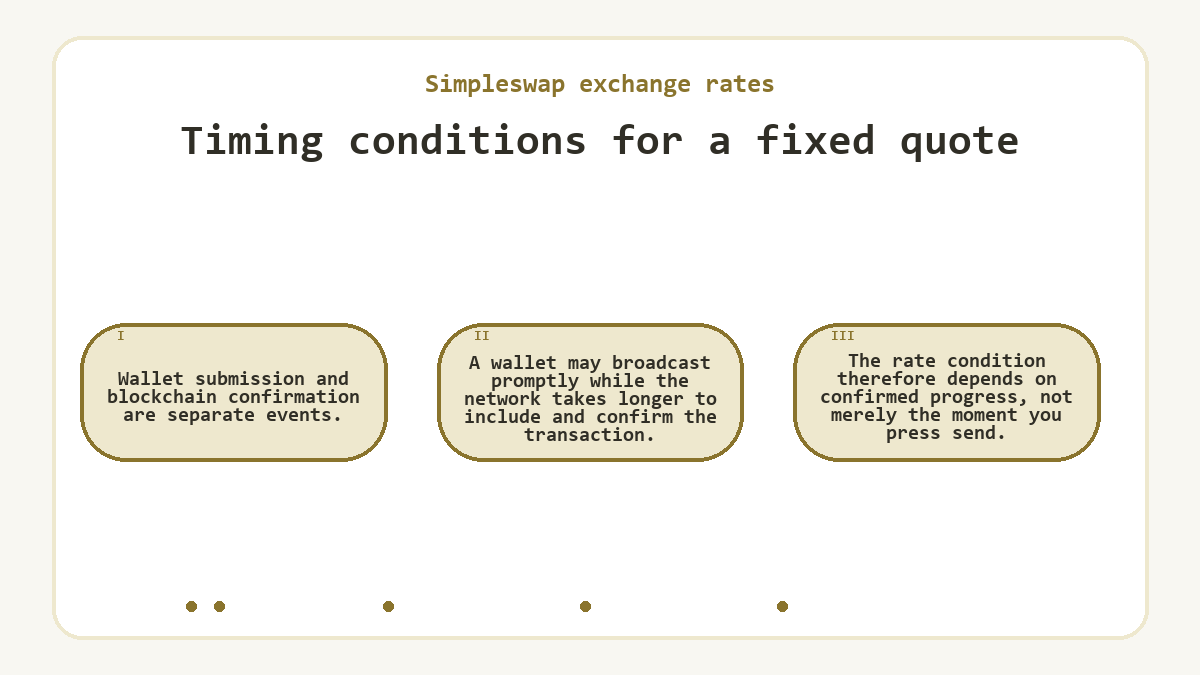
Wallet submission and blockchain confirmation are separate events. A wallet may broadcast promptly while the network takes longer to include and confirm the transaction. The rate condition therefore depends on confirmed progress, not merely the moment you press send.
Further confirmation requirements may still affect processing time because networks and assets use different confirmation rules. The first confirmation preserves the fixed-rate condition within the stated window; it does not necessarily mean the payout can begin immediately.
Floating estimates move with execution conditions
A floating estimate gives a provisional receiving amount when the order is created. Processing later applies the available market rate, liquidity, and network conditions, so the final output may rise or fall. Confirmation delays matter because they extend the interval between the initial estimate and execution.
Floating exchanges do not carry the same strict deposit deadline or upper-amount restriction as fixed quotes. They still require at least the minimum displayed for the order, and execution remains subject to liquidity, network conditions, and operational checks. “Floating” describes how the rate moves; it does not mean every amount or pair is continuously available.
What changes between the quote and the final output?
The final output changes when an estimate encounters different market pricing, available liquidity, or network conditions before processing. These inputs matter most for a floating order because its displayed amount is provisional. A fixed order transfers market-movement risk to the rate provider during the valid window, provided the deposit meets the confirmation condition.
Quote time and execution time are therefore different reference points. The first records the terms available when the order was prepared. Execution time determines a floating outcome. Deposit and confirmation timing determine whether a fixed commitment remains valid. An output difference does not by itself identify one cause, so the rate type and order status should be read together.
Quote comparison on equal terms
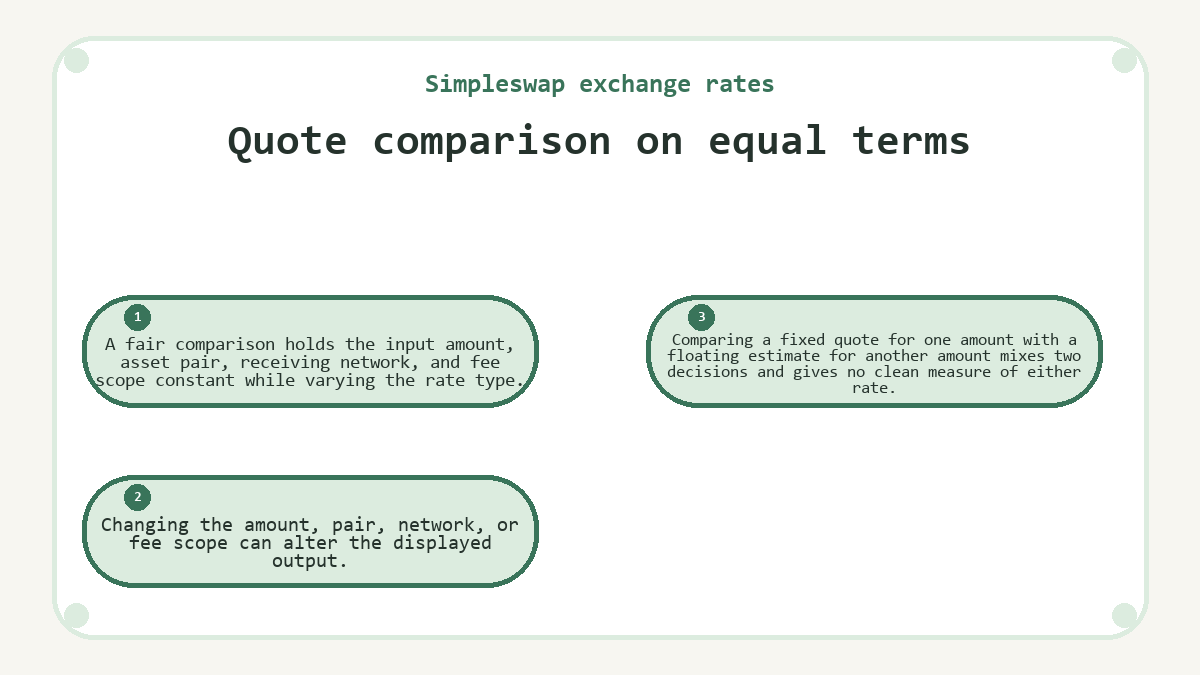
A fair comparison holds the input amount, asset pair, receiving network, and fee scope constant while varying the rate type. Changing the amount, pair, network, or fee scope can alter the displayed output. Comparing a fixed quote for one amount with a floating estimate for another amount mixes two decisions and gives no clean measure of either rate.
Timing also matters. Two floating estimates requested at different moments can reflect different markets even when every form value matches. Fixed quotes from separate attempts may also differ because each quote belongs to its own validity window.
The displayed receiving amount is the most useful common measure when fee treatment matches. A headline conversion ratio can hide whether an estimated network fee already affects the output.
For a completed exchange, an effective executed rate can be calculated by dividing the delivered output amount by the deposited input amount. Keep each asset unit visible, and treat any separate fee charged by the sending wallet outside that ratio. This distinguishes the exchange output from the total reduction in the sender's wallet balance.
Network fees and displayed amounts
Network-fee treatment determines whether two displayed outputs describe the same cost boundary. For a fixed exchange, the network fee for sending the converted asset to the receiving address is included in the shown receiving amount. The sender's wallet may charge a separate fee for delivering the initial deposit to the assigned address.
That deposit-side fee goes to the relevant blockchain network rather than becoming part of the quoted output. Before sending, check how the wallet presents its transfer amount and fee so the order receives the specified deposit. Network load can affect both the fee estimate and confirmation speed, even when the fixed conversion rate itself remains protected.
Availability, minimums, and liquidity
Live availability determines which rate types appear for a selected pair and amount. Fixed quotes may have amount limits because the provider carries market-movement exposure during the lock. Floating exchanges have no strict upper amount limit, but available liquidity, current exchange conditions, and internal checks still govern execution.
Every order also displays a minimum deposit based on the selected pair and current conditions. Sending less can prevent normal processing and may limit refund options. Pair availability can vary with liquidity, maintenance, location, or regulatory restrictions, so an earlier quote does not prove the same path remains open later.
Late fixed quotes and changed outcomes
A late fixed deposit does not have one automatic outcome. If the estimated fixed rate remains unchanged, the exchange may still proceed at the original rate. If the rate has moved, the order may receive a failed status and offer a refund or completion at a newly indicated rate.
The available action depends on the actual order state. Once funds have been sent, cancellation and edits may no longer be available during confirmation, exchange, or payout. Creating another quote does not move the existing deposit into the new order.
Keep the exchange identifier and deposit transaction record when the displayed outcome changes. They connect the original quote with the received deposit and any later payout or refund. This makes a delayed fixed order distinguishable from a new quote created after the rate window ended.
Final output as the decision record
The final exchange record shows a payout, a changed offer, a failure, or a refund. For a floating exchange, compare the delivered amount with the earlier estimate. For a fixed exchange, check whether the timing condition was met and whether the original rate remained attached to the order.
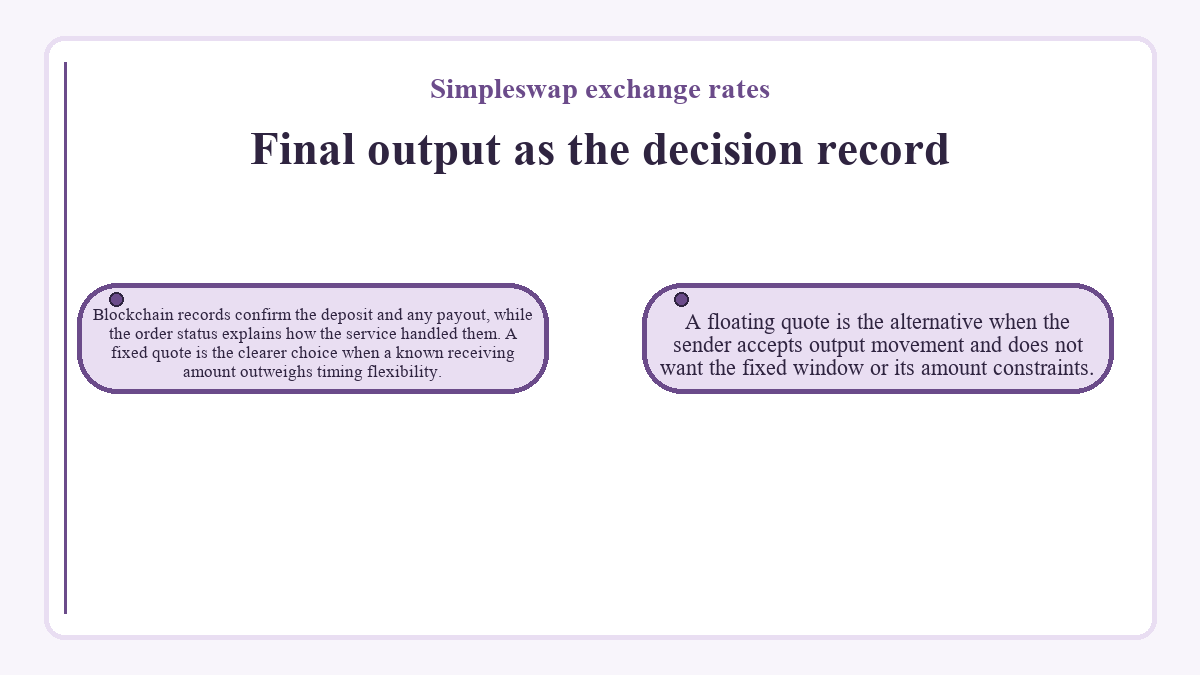
Blockchain records confirm the deposit and any payout, while the order status explains how the service handled them. A fixed quote is the clearer choice when a known receiving amount outweighs timing flexibility. A floating quote is the alternative when the sender accepts output movement and does not want the fixed window or its amount constraints.
Questions and answers about Simpleswap exchange rates
Can I request a fresh quote without sending the first deposit?
Yes. An unpaid exchange can be left unused, and a new order can provide a fresh rate. The new quote has its own exchange identifier, deposit address, amount, and timing conditions. Do not send funds to the first order after deciding to replace it, because the service associates each deposit address with its specific exchange.
Under what conditions can a floating exchange pause for approval?
A floating exchange may pause when the amount available during processing differs significantly from the earlier estimate. The service may then offer a refund or request approval to continue at the newly indicated rate. Smaller market movements can simply produce a higher or lower final output because the floating rate follows execution-time conditions.
Will a valid fixed quote guarantee successful execution?
No. A fixed quote protects the receiving amount from market movement only when its timing and deposit conditions are met. Execution can still fail because of an incorrect asset, wrong network, insufficient amount, missing identifier, market disruption, or another order-specific issue. The rate commitment does not override the technical and operational requirements attached to the exchange.