Simpleswap transaction limits determine which deposit amounts a quote can accept
Simpleswap transaction limits set the accepted deposit range for a specific quote, pair, network, and rate type. An amount below the displayed minimum may fail and might not be refundable, while a fixed-rate order can also have a maximum. Read the live range before sending any funds.
Amount-related messages and status clues
Amount-related messages reveal different stages of a problem. A minimum or maximum shown while preparing an exchange describes the range available for that quote. A message refusing the entered amount points to a pre-deposit boundary. It does not mean an on-chain transaction has failed because no transfer has occurred yet.
Order statuses show where an order is in the exchange process. Pending deposit means the exchange is waiting for funds. Confirming means the deposit has been detected and is waiting for blockchain confirmations. Failed reports an unsuccessful exchange, but the label alone does not prove the amount caused it. Verifying indicates additional monitoring, while Expired means a required action was not completed in time.
Compare the visible status with the blockchain record before changing anything. If no transaction was broadcast, the amount can be corrected through a new quote. If funds already moved, the Exchange ID and deposit TXID become the evidence needed to distinguish an amount mismatch from a confirmation delay, liquidity issue, or review.
The accepted range belongs to the live quote
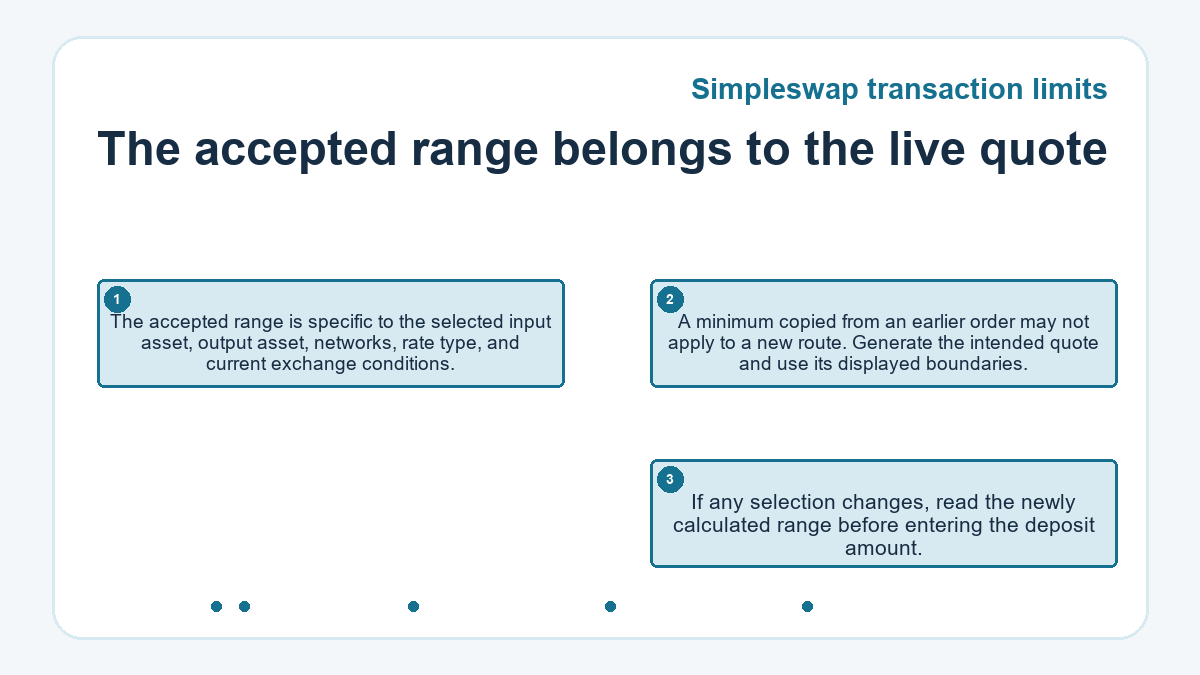
The accepted range is specific to the selected input asset, output asset, networks, rate type, and current exchange conditions. A minimum copied from an earlier order may not apply to a new route. Generate the intended quote and use its displayed boundaries. If any selection changes, read the newly calculated range before entering the deposit amount.
Five parameters governing amount acceptance
The current quote supplies its minimum and any maximum. The selected rate type determines the timing rule and whether an upper limit applies, while the wallet shows the deposit-side network fee. The table separates each value from the consequence of crossing its boundary.
| Parameter | Documented value | Required condition | Boundary or consequence |
|---|---|---|---|
| Minimum deposit | The minimum displayed for the live quote | The deposit reaching the assigned address must meet or exceed it | A lower deposit may fail, and recovery is not guaranteed |
| Fixed-rate maximum | The maximum available for that fixed quote | The requested input must remain within the displayed range | A larger amount requires another available quote or rate choice |
| Floating-rate maximum | No strict preset upper amount limit | The route still needs sufficient liquidity and must pass applicable checks | Large amounts remain subject to current availability |
| Fixed-rate window | 20 minutes | The deposit and at least one confirmation must arrive within the window | A late deposit may lose the fixed outcome |
| Deposit-side network fee | A separate, variable blockchain fee | The wallet must still transmit the amount required by the quote | A fee deducted from the transfer can create a short deposit |
| Range summary | Use the values attached to the current order | Check the amount the wallet will actually send | Stop before broadcast if any boundary is unresolved |
The displayed minimum remains relevant to both rate types. The absence of a strict floating-rate maximum does not remove that lower boundary. It also does not promise unlimited liquidity for every pair or network at every moment.
What should change before a retry?
A retry should change only the input responsible for a pre-deposit mismatch. If the form rejects an amount before any transfer, leave the unpaid order unused and generate a fresh quote after correcting the amount, rate type, or route.
Start with the visible difference between the expected range and the value entered. Record the selected assets, both networks, rate type, displayed minimum, any displayed maximum, and the amount the wallet is preparing to send. This comparison keeps a range problem separate from a network or address problem.
Compatibility comes before another amount attempt. The sending wallet must support the selected input asset and network, while the recipient must support the chosen output network. Changing either network creates a different route, so the previous range should not be carried over.
Next, inspect the wallet confirmation screen without broadcasting. Compare the transfer amount with the network fee and total debit. If the wallet subtracts its fee from the entered amount, the deposit may arrive below the quote even when the wallet balance covered the original number.
Stop the retry sequence once the wallet has broadcast the deposit transaction. A second unscheduled transfer to the same deposit address is not a reversible correction. Preserve the order details and TXID, then use the support path for the existing exchange.
Network fees can create a short deposit
The deposit-side network fee is paid when the sending wallet broadcasts the transaction. It is separate from the amount shown as the expected output of the exchange. Depending on the wallet and send mode, the fee may be added to the total debit or taken from the value being transferred.
The distinction matters near the minimum. A wallet can show enough balance to begin a transfer while preparing an on-chain amount below the required deposit. Review the exact amount sent to the assigned address, not only the balance reduction. If the transfer has not been signed, adjusting the wallet input is still reversible. Once it has been broadcast, use its transaction record to diagnose the amount and confirmation state instead of sending another deposit.
Fixed-rate limits combine amount and time
A fixed-rate limit includes an upper amount boundary because the quoted receiving amount is protected against market movement for a limited period. The available maximum can depend on the pair, liquidity, and conditions present when the order is created. A number from another fixed-rate order is therefore unsuitable for the current deposit.
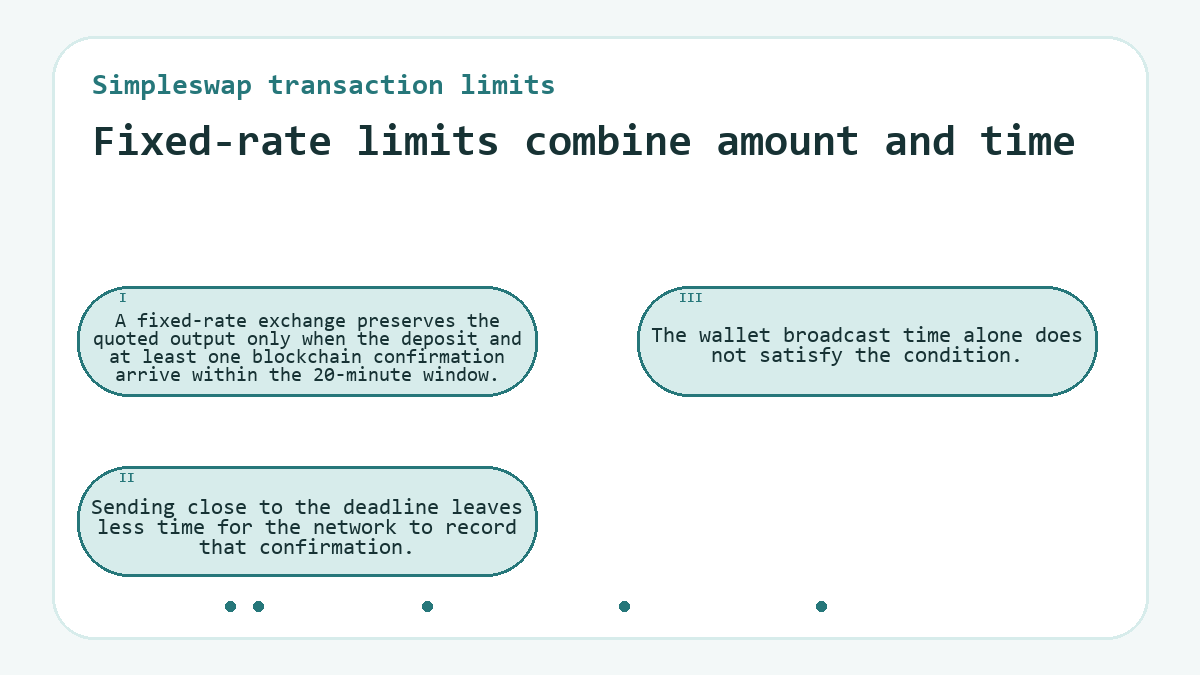
A fixed-rate exchange preserves the quoted output only when the deposit and at least one blockchain confirmation arrive within the 20-minute window. Sending close to the deadline leaves less time for the network to record that confirmation. The wallet broadcast time alone does not satisfy the condition.
A deposit confirmed after the window may fail or require a different outcome. Depending on the case, the available response may involve a new rate or a refund. Neither path should be assumed before the exchange status is checked. The amount can be valid while the fixed-rate timing condition is not.
Floating-rate capacity remains conditional
A floating-rate quote has no strict preset upper amount limit, but it still has a displayed minimum and depends on available liquidity, network conditions, and applicable internal checks. Its final output can also move with the market during processing. For an unusually large transfer, confirm current availability before broadcasting rather than treating the absence of a cap as guaranteed execution.
Evidence for a limit-related support case
A limit-related support record should identify the exchange without exposing wallet secrets. Keep the values needed to compare the quote with the transaction:
- The Exchange ID for the affected order
- The selected input and output assets and networks
- The displayed minimum and maximum, if shown
- The amount recorded in the deposit TXID
- The current exchange status and relevant timestamps
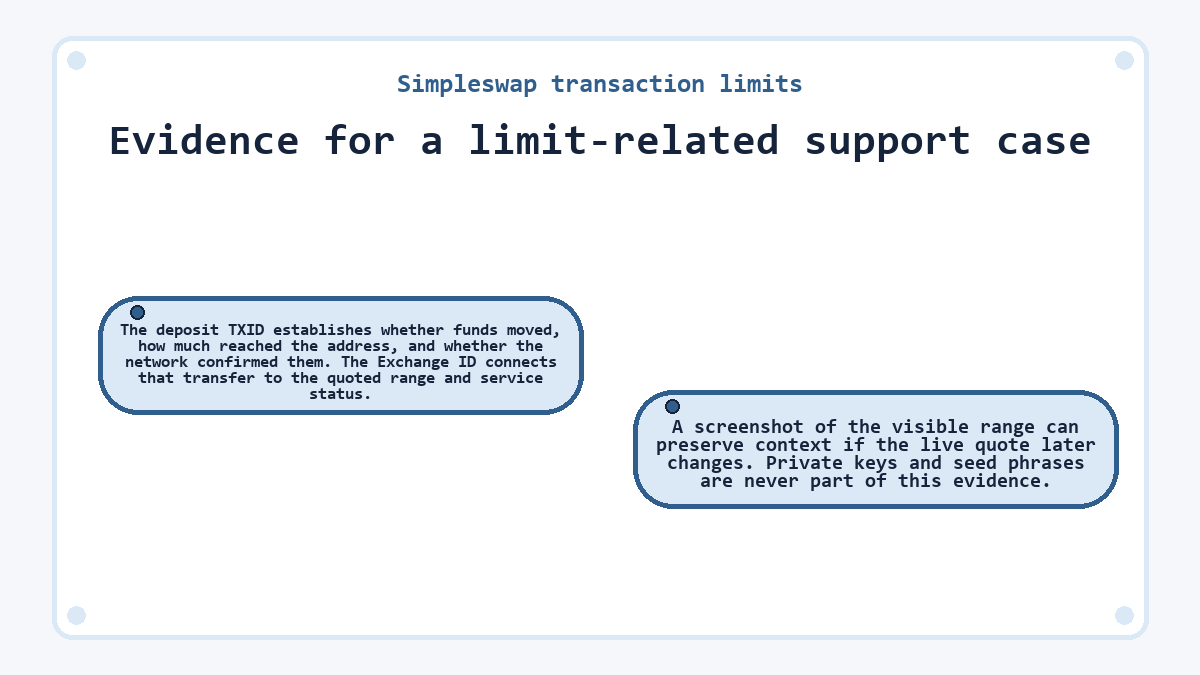
The deposit TXID establishes whether funds moved, how much reached the address, and whether the network confirmed them. The Exchange ID connects that transfer to the quoted range and service status. A screenshot of the visible range can preserve context if the live quote later changes. Private keys and seed phrases are never part of this evidence.
Below-minimum deposits have uncertain recovery
A below-minimum deposit may be too small for the exchange to process. The exchange can fail, and a refund is not guaranteed. Sending more funds later does not automatically repair the first transaction because the original order was created for a particular amount and deposit event.
Once the transfer is confirmed, it cannot be cancelled from the sending wallet. Check the order status and keep its identifiers before contacting support. Any available refund or revised exchange depends on the recorded transaction and the review of that case. Do not interpret a Failed, Verifying, or Expired label as proof a refund has already been issued.
Verification before funds leave the wallet
The final check compares the quote boundaries with the transaction the wallet will broadcast. Confirm the input asset and network, output network, rate type, displayed minimum, any fixed-rate maximum, and exact transfer amount. Then compare the wallet fee treatment with the amount expected at the assigned deposit address.
Check the recipient address and any required memo or tag before signing because amount validity does not correct an incompatible destination. If one field differs from the quote, stop and create a corrected order while the action remains reversible. When every value matches, save the Exchange ID and submit the deposit once. A new quote changes the governing range, so repeat the check whenever the route or rate type changes.
Things people ask about Simpleswap transaction limits
-
Can the accepted range differ between quotes?
- Yes. A later quote can show a different range because the selected pair, networks, rate type, liquidity, network fees, and exchange conditions may have changed. Use the boundaries attached to the order you intend to fund. If you alter an asset, network, or rate type before sending, generate a new quote and review its range again.
-
Which amount matters when my wallet adds a sending fee?
- The relevant deposit amount is the value the wallet actually sends to the assigned address. Some wallet flows add the network fee to the total debit, while others may subtract it from the entered amount. Read the confirmation screen before signing and make sure the transferred value itself meets the displayed minimum.
-
Does changing the receiving network change the displayed limits?
- It can. The selected input and output networks are part of the route used to calculate an exchange range. A different receiving network can change availability, liquidity, and network-related costs. After changing either network, treat the transaction as a new route and use the minimum and maximum shown by its new quote.
-
Are fiat purchase limits the same as crypto exchange limits?
- No. Fiat purchase boundaries depend on the third-party payment provider, region, payment method, currency, verification rules, and available offer. Crypto-to-crypto limits come from the selected exchange route and rate type. A range displayed for a crypto deposit should not be reused when evaluating a card or other fiat purchase.
-
Can support guarantee a refund for a deposit below the minimum?
- No. A deposit below the displayed minimum may be insufficient to complete, and a refund is not guaranteed. Preserve the Exchange ID, deposit TXID, on-chain amount, and current status for review. Do not send an additional transfer to the same deposit address unless the instructions for that specific exchange explicitly require it.
-
When should a large floating-rate exchange be checked with support?
- Check availability before sending whenever the amount is large enough that liquidity or route capacity is uncertain. Floating-rate exchanges have no strict preset upper amount limit, but they remain subject to liquidity, network conditions, and internal checks. Contact support before sending to check whether the selected route is available for the intended amount.
-
Can a deposit within the quoted range still enter Verifying?
- Yes. Amount validation and transaction review are separate conditions. A deposit can fall within the quoted range and still enter Verifying if a compliance or partner review applies. Likewise, passing a review does not repair an amount below the minimum. Follow the recorded status and provide only the information requested through the proper support channel.